
Movement & balance · Free playbook
The Strong Back Playbook
Understand the support underneath the back. Build quality before difficulty.
When someone tells you your horse needs a stronger back, the next question should be: what are we actually asking the horse to do? Start by understanding how the body supports itself, then build a few good movements into a consistent routine.
Step 01
The back works as a system
Think of the back and the muscles underneath the body as parts of one support system. The bow-and-string idea is a useful starting picture: the abdomen helps support the trunk, while the muscles around the spine help control and stabilize movement.
That does not mean the muscles on top of the back do nothing. The job changes with the exercise. Watch for controlled movement and a comfortable horse, rather than trying to force a particular shape.
Research behind this lesson
[1] Aulinas Coll, Blake & Ferro de Godoy (2023): muscle activity and lumbosacral movement during core exercisesWhat supports
a lifted back?
Start underneath the horse, then look at the support close to the spine. Select a muscle group to see its role.
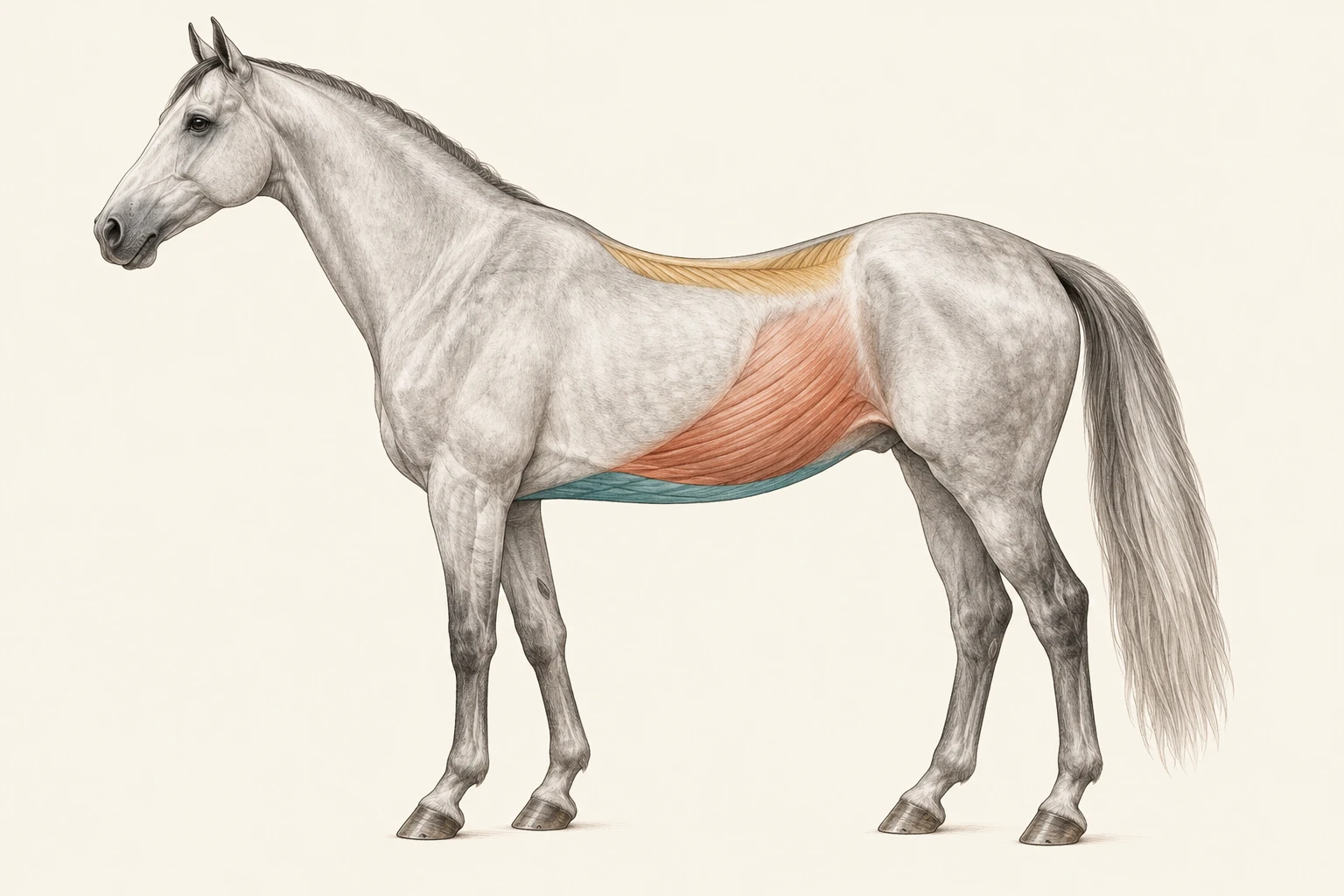
Rectus abdominis
Support from underneath
The rectus abdominis runs along the underside of the abdomen. It is part of the abdominal system involved in supporting the trunk and flexing the back.
Think of support coming from underneath the horse, with a comfortable, coordinated effort. A bigger stretch is not automatically a better stretch.
Read the research: 2023 core-exercise study ↗Illustrative muscle regions, not a complete anatomical atlas. The deeper spinal region is shown schematically. Back lift involves coordinated movement throughout the horse, not one muscle acting alone.
Step 02
Start with comfort
The next step builds on what you have just learned.