
Movement & balance · Free playbook
Hindquarter Engagement
Build reach, balance, and connection from the ground to the saddle.
The purpose of this guide is to help your horse find true engagement of the hindquarters. Engagement is more than just moving forward. It is about the horse stepping under with the hind legs, lifting the back, freeing the shoulders, and carrying themselves with balance and power. These six steps start on the ground and build all the way to simple engagement under saddle. The exercises are progressive. Each one lays the groundwork for the next, creating strength, mobility, and understanding in your horse. Take your time with each step. Do not rush. Progress comes from consistency and clarity, not speed.
Step 01
Stepping Up
This first step lays the foundation for hindquarter engagement. Before we can create improvement, we need to establish a baseline. Every horse has a natural way of moving. Some are forward, others are a bit lazy, and most fall somewhere in between. Our goal is to see where your horse is starting from and then begin teaching them how to bring their hind legs further underneath the body.
How to do it
- 1. Use a 15-foot line and a dressage whip. Toss the line over the horse’s neck so it is out of the way and hold near the snap for control.
- 2. First make sure your horse is not afraid of the whip. Rub it along their body until they stay relaxed.
- 3. Begin by walking your horse forward as you back in a small circle. Use gentle taps on the belly or flank to encourage them to step underneath.
- 4. Watch closely. Are the hind feet reaching up toward the front footprints, or falling short? This tells you your horse’s baseline.
- 5. From that baseline, start asking for a little more reach and mobility. Reward every time they increase the step. If your horse speeds up instead of stepping deeper, simply use your lead hand to slow them and redirect that effort into engagement, not speed.
What supports
a lifted back?
Start underneath the horse, then look at the support close to the spine. Select a muscle group to see its role.
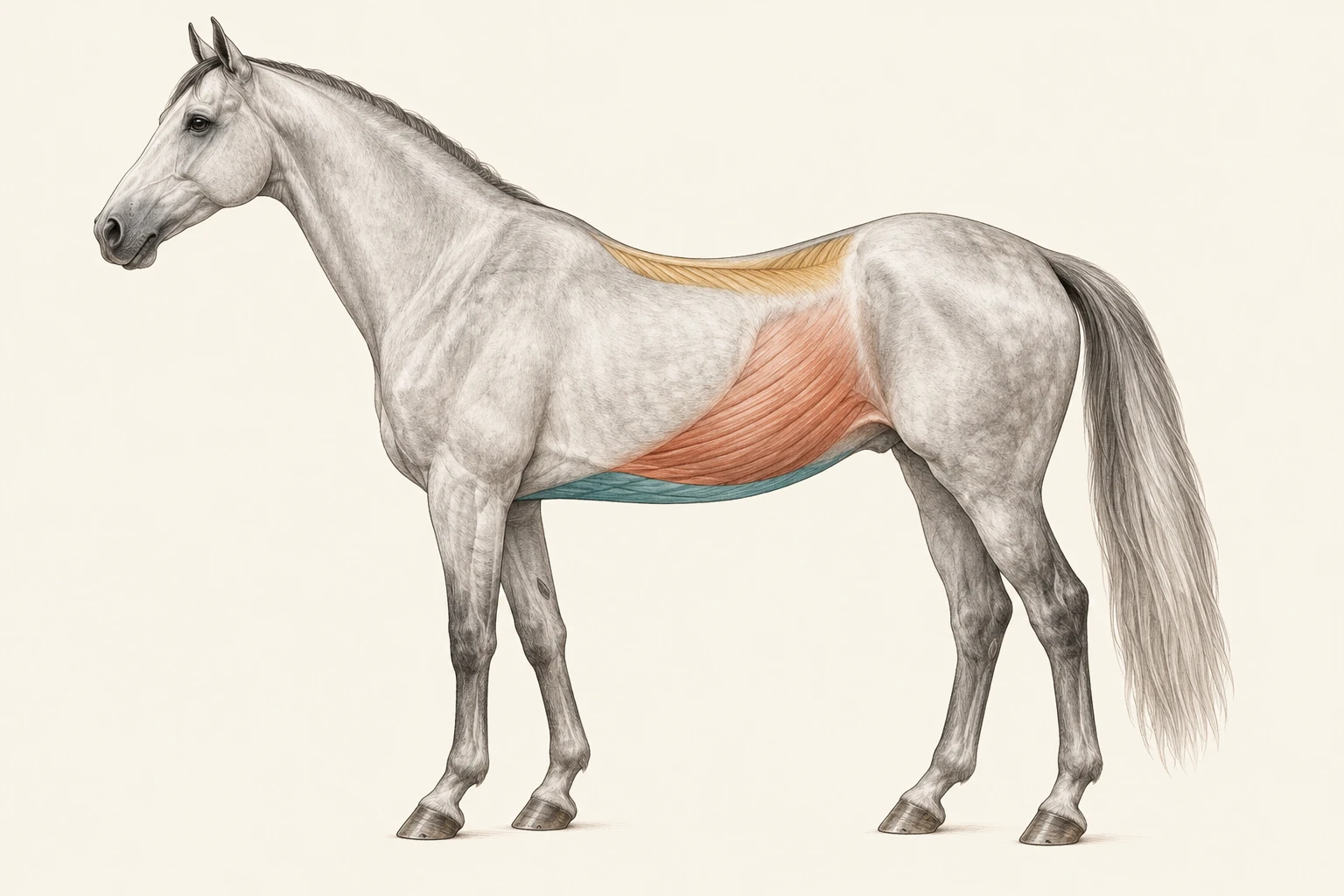
Rectus abdominis
Support from underneath
The rectus abdominis runs along the underside of the abdomen. It is part of the abdominal system involved in supporting the trunk and flexing the back.
Think of support coming from underneath the horse, with a comfortable, coordinated effort. A bigger stretch is not automatically a better stretch.
Read the research: 2023 core-exercise study ↗Illustrative muscle regions, not a complete anatomical atlas. The deeper spinal region is shown schematically. Back lift involves coordinated movement throughout the horse, not one muscle acting alone.
Step 02
Flexion
The next step builds on what you have just learned.